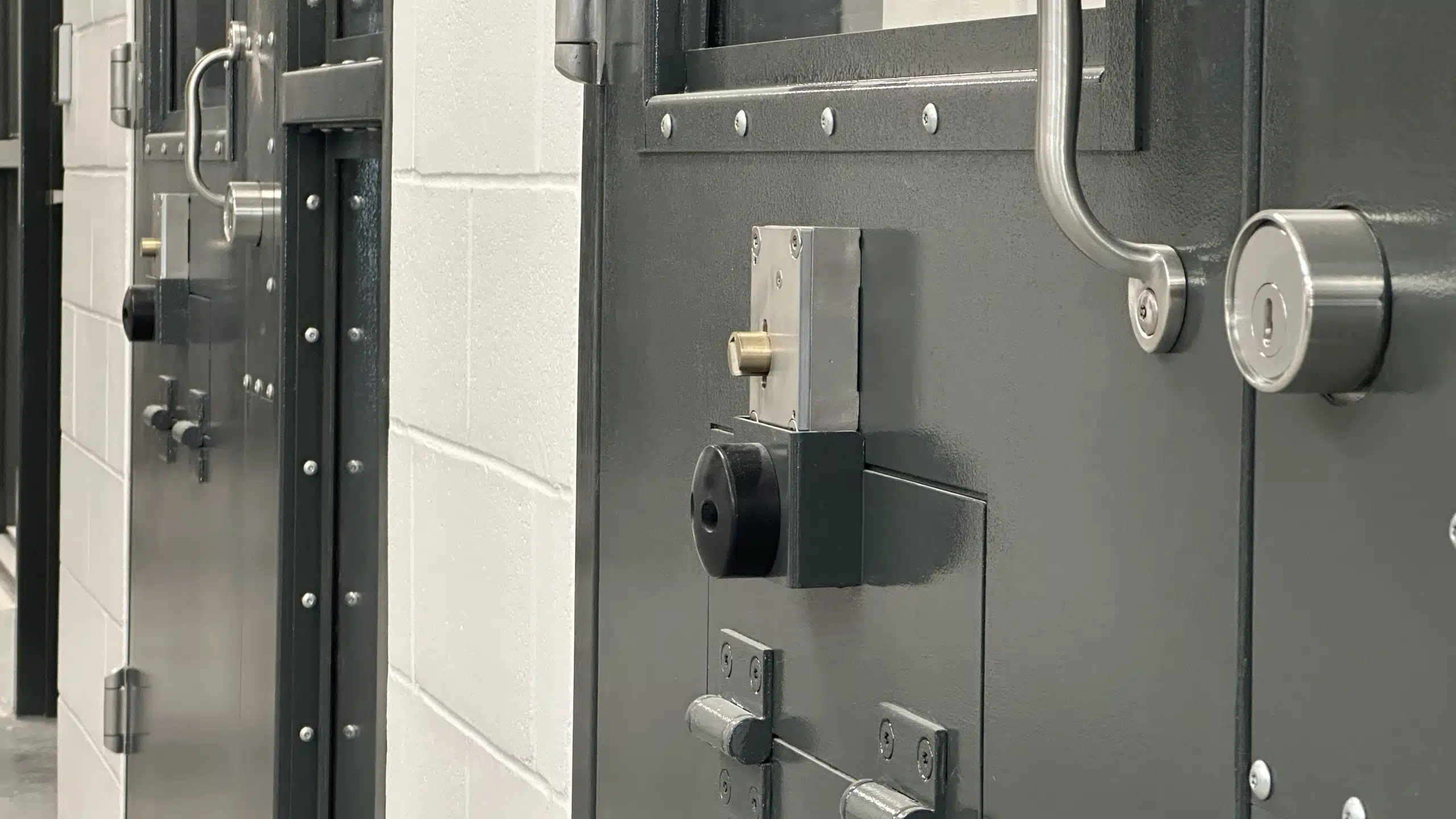

The Kuwait Prison Fire: Context and Importance
The incident occurred during maintenance work and was linked to an electrical issue. Several personnel were injured, emergency services responded promptly, and an official investigation was launched.
While no public conclusions have yet been issued regarding building systems or operational causes, the seriousness of the incident has naturally drawn attention to fire safety in secured facilities, particularly where electronic access control systems regulate movement.
Why Access Control Matters in a Fire
In prisons, hospitals, and government buildings, doors are not passive elements. Movement is managed by electronic access control systems designed to enforce security under normal conditions.
During a fire, however, the priority changes immediately. At that moment, access control systems must support safe, fast, and intuitive evacuation.
In emergency conditions, doors must:
- Unlock automatically and without delay
- Require no key, card, code, or technical knowledge
- Behave predictably, even if power or networks are affected
Any hesitation or uncertainty at exit points can significantly increase risk.
When Technology Becomes a Constraint
Experience from fire investigations worldwide shows that serious outcomes are often not caused by dramatic system failures. Instead, they occur when systems behave differently under emergency conditions than occupants expect.
This risk increases when:
- Doors rely on software or networks to unlock
- Backup power sustains locking behaviour during evacuation
- Fire alarms do not clearly override access control
- Emergency release devices are unclear or difficult to access
In smoke-filled, high-stress environments, people act instinctively. Doors that do not open immediately can lead to confusion, delay, and congestion.
A Brief Global Perspective
Internationally, there are documented fire incidents where electronically controlled doors delayed or prevented escape, contributing to fatalities. A widely referenced example is the 2019 Koszalin Escape Room fire, where occupants were unable to exit because an electronically controlled door could not be opened from inside, leading to multiple deaths and subsequent regulatory reform.
Similar findings have emerged from fires in healthcare and industrial settings, where evacuation depended on electronic release or staff intervention that proved impossible under fire conditions. These cases help explain why access control is now widely regarded as a life-safety consideration, not merely a security feature.
Regulatory Context in Kuwait and the GCC
An important part of this discussion is the fire safety regulatory framework in Kuwait.
Kuwait Fire Force (KFF) Law No. 13 of 2020 and its implementing codes focus primarily on fire detection, suppression, evacuation planning, and fire door performance. They provide limited explicit guidance on electronic locking systems, beyond references to magnetic door holders used to keep fire doors open during normal operation and allow them to close automatically during a fire.
In practice, Kuwait commonly adopts or references GCC unified fire prevention standards, which are recognised by the Kuwait Fire Force. Within these GCC standards, a clear and consistent requirement applies:
Emergency exit doors must permit immediate egress without the use of any key, card, code, or electronic device — even if electronic locking is used for normal access control.
This principle ensures that electronic access control can never impede escape during a fire, regardless of system complexity or power state.
Alignment With International Fire Safety Standards
The GCC approach aligns closely with international life-safety guidance, including principles reflected in NFPA codes.
Across these standards, the hierarchy is clear:
- Fire alarms must automatically override access control
- Escape must not depend on electronics, credentials, or staff intervention
- Doors on escape routes must allow immediate and intuitive exit
Where electronic locking is used, it is acceptable only when life safety is unambiguously prioritised and reliably assured.
A Simple but Critical Design Principle
Electronic locks generally behave in one of two ways when power is disrupted:
- Fail-safe: the door unlocks
- Fail-secure: the door remains locked
For fire exits and escape routes, fail-safe behaviour is essential.
If power is lost or systems are damaged, doors must default to opening — not remaining closed.
Why Mechanical Overrides Still Matter
Despite advances in technology, simple mechanical exit devices remain critical.
Break-glass units, push-to-exit buttons, and panic bars are effective because they:
- Work independently of software and networks
- Are easy to understand under stress
- Provide a final layer of safety if electronic systems fail
In emergencies, simplicity saves time - and time saves lives.
Closing Reflection
The Kuwait prison fire is a reminder that fire safety is not only about alarms, detectors, or firefighting response. It is also about how everyday systems — especially access control — behave when conditions suddenly change.
Where guidance on electronic locking is limited, responsibility shifts to designers, integrators, consultants, and authorities to ensure that security systems do not introduce unintended risk.
Access control should never require explanation during a fire.
It should simply allow people to get out.
About Aspire Security
Aspire Security has experience designing and implementing access control systems integrated with fire detection and alarm systems, including in complex and high-security environments.
Our approach is based on:
- Practical fire system integration experience
- Familiarity with Kuwait Fire Force requirements, GCC standards, and international best practice
- Access control design that prioritises safe egress, clear system hierarchy, and predictable behaviour in emergencies