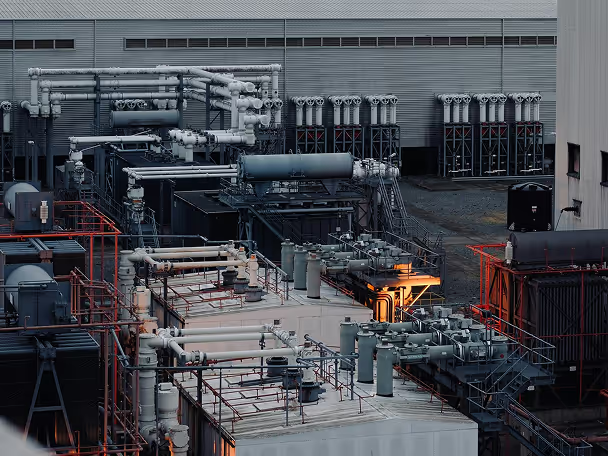
Every warehouse, workshop, scrap yard, storage site and petrol station in Kuwait's industrial areas is legally required to operate an approved security camera system under Law 61/2015, and in 2026 the authorities began actively enforcing it. Systems must meet Ministry of Interior specifications, keep 120 days of footage, and cover the ground both inside and around each site. Falling short carries fines of up to KD 20,000 and prison terms of up to five years.

If you hold a plot in Shuwaikh, run a scrap yard in Amghara, or operate storage in East Ahmadi, this guide covers exactly what the law expects, which cameras pass inspection, how long you have, and how to get compliant without overbuying.
The Short Version
- The rule: Law No. 61 of 2015 requires covered establishments to install and run security surveillance cameras around the clock, to Ministry of Interior specifications.
- The 2026 push: In May 2026, the Public Authority for Industry directed all industrial area occupants (investors and plot owners, craft and industrial licence holders, scrap plot and storage site operators) to comply "speedily", with cameras inside and around their sites.
- The specs: Ministerial Decision 5003/2015 requires Full HD indoor cameras, IP66 day/night outdoor cameras, infrared to 20 metres, and defined fields of view for every zone.
- The retention rule: Recordings kept for 120 days, then destroyed without alteration (Article 5).
- The stakes: Fines from KD 500 to KD 20,000 and up to five years' imprisonment, depending on the violation (Articles 11 to 14).
- The authority: The General Department of Security Systems at the Ministry of Interior, opposite the Amiri Airport, approves layouts and answers enquiries.
Why CCTV Compliance in Kuwait's Industrial Areas Suddenly Matters
The obligation isn't new; Law 61/2015 has been on the books for a decade. What changed is enforcement. For years, attention centred on banks, malls and hotels. In May 2026, it turned squarely to the industrial areas: the Public Authority for Industry formally instructed every investor, plot owner, licence holder, and scrap or storage site operator covered by the law to take the necessary measures "speedily."
Three details in that directive deserve your attention.
First, the coverage wording: cameras are required inside and around each site. A system that watches your workshop floor but ignores the yard, the fence line and the access road doesn't meet the brief.
Second, there is no grace period. No calendar deadline was set, because none is needed. The obligation stems from a 2015 law, so an unequipped site isn't waiting for a compliance date; it's already exposed.
Third, the directive names names. Scrap plots and storage sites, categories that often assumed the rules applied to someone else, are called out explicitly.
For the full technical and legal requirements, the authorities point to one place: the General Department of Security Systems at the Ministry of Interior, located opposite the Amiri Airport.
Who Needs Security Cameras in Kuwait's Industrial Areas?
Four groups are directly addressed:
- Investors and plot owners in the industrial areas
- Holders of craft and industrial licences
- Operators of scrap plots and storage sites
- Any establishment covered by Law 61/2015 located within an industrial zone
That last category is broad. Under Article 1 of the law, the establishments most relevant to industrial areas include warehouses and private stores (especially those holding valuable or hazardous materials), petrol stations, oil facilities, electricity and water power stations, and commercial complexes and showrooms, plus the supporting facilities that dot industrial plots: bank branches, exchanges, clinics and cooperative outlets.
One boundary runs the other way, and it catches operators with on-site labour accommodation: Article 9 prohibits cameras in sleeping and dwelling areas, toilets, changing rooms and similar private spaces. Compliance is as much about where cameras must not point as where they must.
What Are the MOI's Camera Specifications?
Ministerial Decision 5003/2015 sets the technical floor: Full HD indoor cameras, weatherproof day/night outdoor cameras, infrared reach of at least 20 metres, and a defined field of view standard for every zone of the facility.
| REQUIREMENT | MOI SPECIFICATION |
|---|---|
| Indoor fixed cameras | Full HD: 3MP at 20fps, or 2MP at 25fps |
| Outdoor cameras | IP day/night speed dome, 2.0MP at 25fps, weatherproof IP66 housing |
| Night capability | True day/night function with IR cut filter; built-in infrared to at least 20 metres in complete darkness |
| Recording system | NVR/server recording all cameras for the full retention period |
| Entrances and exits (including emergency exits) | Field of view sufficient to identify individuals |
| Car park entrances and exits | Vehicle recognition: readable licence plates |
| Lobbies, corridors, lifts and stairs | Field of view sufficient to recognise persons and detect activity |
Those three verbs, identify, recognise and detect, are the heart of the standard. A camera can be expensive and still fail if it's mounted where faces blur or plates wash out at night.
Two obligations are missed so often they deserve their own paragraph. The law requires a central control room for the system (Article 2), and it gives the MOI the right to require a direct link between your cameras and the ministry's own systems where public interest demands it. And Article 4 requires visible warning signs telling people the premises are monitored. Skipping the signage is a punishable offence all by itself.
Finally, don't design your own layout. Article 3 empowers the General Department of Security Systems to determine camera locations, points and quantities for each facility, which means no two compliance layouts are identical. A proper site survey against the MOI's requirements, not a template lifted from another plot, is the correct starting point.
How Long Must CCTV Footage Be Kept in Kuwait?
120 days. Article 5 of Law 61/2015 requires recordings to be retained for 120 days and then destroyed without alteration. It is one of the strictest retention rules in the region.
This single number quietly drives the design of the whole system. The recorder must hold footage from every camera for the full period (recording at up to 15fps on motion), so storage has to be engineered around camera count, resolution and site activity from day one. A recorder that keeps 30 days of footage isn't a quarter compliant. It's non-compliant. Undersized storage is the most common reason otherwise well-installed systems fail inspection.
There's a confidentiality rule too: under Article 6, footage may not be handed over, published or shared with anyone without the written approval of the competent investigating authority or the court.
What Happens If You Don't Comply?
The penalties are criminal, not administrative. They range from a KD 500 fine for missing signage to five years' imprisonment for misuse of footage:
| VIOLATION | PENALTY |
|---|---|
| Failing to install or operate cameras around the clock, or failing to maintain them (Articles 2 and 7) | Up to 1 year imprisonment and/or a fine of KD 1,000 to 5,000 (Article 11) |
| Deleting or modifying footage before 120 days, unlawfully sharing footage, or installing cameras in prohibited private areas (Articles 5, 6 and 9) | Up to 3 years imprisonment and/or a fine of KD 2,000 to 10,000 (Article 12) |
| Failing to display the required camera warning signs (Article 4) | Fine of KD 500 to 1,000 (Article 13) |
| Misusing footage to defame, extort or exploit any person | Up to 5 years imprisonment and/or a fine of KD 3,000 to 20,000 (Article 14) |
And the fine is rarely the whole cost. Non-compliance has a way of surfacing at the worst moments: a licence renewal, an insurance claim after a fire, an incident investigation, or the pre-qualification stage of a tender you wanted to win.
How to Get Compliant: Five Steps
- Confirm you're covered. If you're an investor, plot owner or licence holder in an industrial area, or you operate a scrap plot, storage site, warehouse, hazardous materials store or petrol station, assume the law applies to you.
- Get the requirements for your site. Contact the General Department of Security Systems at the MOI, opposite the Amiri Airport. The department determines camera locations and quantities for each facility.
- Survey before you buy. Map entrances, exits, emergency exits, parking access, corridors and the perimeter against the identify, recognise and vehicle recognition standard, remembering the "inside and around" requirement, and mark the Article 9 exclusion zones.
- Install to the specification, not the budget. Full HD indoors, IP66 day/night units with infrared to 20 metres outdoors, a control room, and storage engineered for 120 days across every channel. See our MOI-approved CCTV installation capabilities.
- Finish the paperwork. Put up the Article 4 signage, document your maintenance regime (Article 7), and keep approval records where an inspector can see them.
Frequently Asked Questions
Is CCTV mandatory for industrial facilities in Kuwait? Yes. Kuwait's Law 61/2015 has required covered establishments, including warehouses, hazardous materials stores and petrol stations, to install approved security cameras since 2015. In May 2026, the Public Authority for Industry directed all industrial area occupants, including scrap plot and storage site operators, to comply speedily.
Is there a deadline to install CCTV in Kuwait's industrial areas? No calendar deadline has been set; the 2026 directive requires occupants to act "speedily." Because the obligation comes from Law 61/2015, it already applies: facilities without compliant systems are exposed to penalties now, not from some future date.
How long must CCTV recordings be kept in Kuwait? CCTV recordings in Kuwait must be kept for 120 days, under Article 5 of Law 61/2015. After 120 days the footage must be destroyed without modification, and it may only be shared with written approval from the investigating authority or the court.
What camera resolution does the Kuwait MOI require? Under Ministerial Decision 5003/2015, indoor fixed cameras must deliver Full HD (3MP at 20fps or 2MP at 25fps); outdoor cameras must be IP day/night units at 2.0MP and 25fps in IP66 weatherproof housings, with infrared coverage to at least 20 metres.
What are the fines for not installing CCTV in Kuwait? Under Law 61/2015, failing to install, operate or maintain a compliant system carries up to one year's imprisonment and/or a fine of KD 1,000 to 5,000. Deleting footage early or sharing it unlawfully carries up to three years and KD 2,000 to 10,000, and misuse of footage up to five years and KD 3,000 to 20,000.
Do scrap yards and storage sites in Kuwait need security cameras? Yes. Operators of scrap plots and storage sites are explicitly required to install approved surveillance systems inside and around their sites in Kuwait's industrial areas.
Where do I get MOI approval for a CCTV system in Kuwait? From the General Department of Security Systems at Kuwait's Ministry of Interior, located opposite the Amiri Airport. The department determines the required camera locations and quantities for each facility and holds the full technical and legal requirements.
Can I install cameras in worker accommodation on my industrial plot? No. Article 9 of Law 61/2015 prohibits cameras in sleeping and dwelling areas, toilets, changing rooms and other private spaces. A compliant design covers operational and access zones while excluding these areas entirely.
Get Compliant Before the Inspectors Arrive
Industrial area occupants have been told, in writing, to act quickly. The cost of a compliant system is predictable; the cost of an Article 11 or Article 12 violation is not.
Aspire Security designs, installs and maintains MOI-approved surveillance systems built precisely to Law 61/2015 and Ministerial Decision 5003/2015, from the site survey and camera schedule to the control room, the 120-day storage design and the Article 4 signage. As an Axis Communications partner of more than a decade, we handle the compliance file as carefully as the cabling.
Book a compliance site survey for your industrial facility today, before enforcement reaches your gate.
Sources and References
- Public Authority for Industry, announcement to investors and plot owners in the industrial areas, Al-Kuwait Alyoum (Official Gazette of the State of Kuwait), Issue No. 1793, 31 May 2026.
- Law No. 61 of 2015 regarding the regulation and installation of security surveillance cameras and devices, State of Kuwait (Ministry of Interior).
- Ministerial Decision No. 5003 of 2015 on the technical specifications for security surveillance cameras and devices, Ministry of Interior, State of Kuwait.
This article is provided for general information and does not constitute legal advice. Requirements for individual facilities are determined by the Ministry of Interior's General Department of Security Systems; always verify current requirements directly with the competent authority.